

Business Operation · 2025
In this section22 topics
- Corporate Information4 items
- Dividend Policy2 items
- Major Shareholders1 item
- Business Strategies Overview5 items
- Material Changes & Developments1 item
- Use of Proceeds from Securities Offerings1 item
- Commitments Made in the Registration Statement1 item
- Group Operating-Structure Policy1 item
- Shareholders with Potential Conflict of Interest1 item
- Relationships Among Major Shareholders1 item
- Shareholders' Agreement1 item
- Shareholding Diagram (Group Structure)1 item
- Income Structure3 items
- Product / Service Characteristics2 items
- Research & Development5 items
- Assets Used in the Business4 items
- Marketing Policy & Competition3 items
- Procurement of Products & Services2 items
- Nature of Business — Overview1 item
- Projects Under Construction1 item
- Debentures & Bills of Exchange1 item
- Convertible Securities1 item
Corporate Information
Company Name
Lanna Resources Public Company Limited
Telephone
0-2253-8080
Website
www.lannar.com
lanna@lannar.com
Dividend Policy
Dividend Policy
The Company’s dividend payment policy to the shareholders: In the case that no additional investment is required and there are no outstanding loans, the Company’s dividend payment policy is not less than 60 percent of its net income according to the separate financial statements for each financial period after deduction of legal provisions and the net loss carried forward (if any).
Historical Dividend Payments
| This Year | Last Year | 2 Years Ago | 3 Years Ago | 4 Years Ago | Metric | Description |
|---|---|---|---|---|---|---|
| 1.18 | 3.13 | 2.87 | 4.43 | 2.23 | Net profit per share (Baht : Share) | Net profit per share (baht : share) |
| 1 | 2.3 | 2.3 | 3 | 1.6 | Dividend per share (Baht : Share) | Dividend per share (baht : share) |
| 0 | 0 | 0 | 0 | 0 | Dividend stock ratio (Number of original shares: dividend shares) | Ratio of stock dividend payment (existing share : stock dividend) |
| 0 | 0 | 0 | 0 | 0 | Dividend share value per share (Baht : Share) | Value of stock dividend per share (baht : share) |
| 1 | 2.3 | 2.3 | 3 | 1.6 | Total dividend payment value (Baht : Share) | Total dividend payment (baht : share) |
| 85.08 | 73.52 | 80.01 | 67.79 | 71.62 | Dividend payout ratio to net profit (%) | Dividend payout ratio compared to net profit (%) |
Business Strategies Overview
Chairman's Message
The global coal consumption in 2025 remained at a high level. Although the overall global market began to stabilize, demand continued to be driven by power generation and industrial activities in emerging economies, particularly in Asia, where economic expansion remains ongoing. This helped offset the decline in coal consumption in developed economies that are increasingly transitioning toward cleaner energy sources. Amid ongoing changes in the global energy landscape, the Company maintained strong operational performance and a solid customer base, supported by the knowledge, expertise, and capabilities of its personnel, particularly in coal supply management and integrated logistics systems. The strength of the Company’s team has been a key factor enabling it to manage market volatility effectively and maintain operational stability in a challenging business environment.
I am pleased to report the Company’s operating results to the shareholders. In 2025, the Company and its subsidiaries generated total revenue of Baht 15,187.50 million and total net profit of Baht 697.59 million. The EBITDA margin was 20.55 percent, and the return on equity was 8.39 percent. As at the end of year 2025, the book value per share was Baht 15.46. In addition, the Company continues to demonstrate a strong commitment to good corporate governance. The Company has joined the “You Demand, We Report” project under the Thai Private Sector Collective Action Against Corruption (“CAC”), in collaboration with the National Anti-Corruption Commission (“NACC”). This initiative aims to collectively reduce corruption in Thailand, strengthen confidence in secure whistleblowing channels, promote a strong corporate culture, and encourage employees to report any misconduct they encounter.
Moreover, the Company received environmental and sustainability-related recognition, including the Sustainability Disclosure Acknowledgement 2025 awarded by the Thaipat Institute for the sixth consecutive year. The Company was also granted a certificate of recognition under the ESG DNA initiative: Sustainability Knowledge for all Employees 2025, in appreciation of its valued collaboration in promoting a sustainability-driven culture within the organization. This supports the Company’s sustainable development while creating long-term value for society and the environment.
A further achievement during the past year was that the Company received two prestigious awards at the “SET Awards 2025”, organized by the Stock Exchange of Thailand in collaboration with Money & Banking Magazine, namely the Outstanding Company Performance Awards, reflecting excellence in corporate management, and the Outstanding CEO Awards, underscoring strong vision and leadership in guiding the organization toward sustainable success. These accomplishments reaffirm the Company’s commitment to delivering sustainable profitability for the benefit of all shareholders, while strengthening its performance across Environmental, Social, and Governance (“ESG”) dimensions.
As Chairman of the Board, together with the Board of Directors, we remain committed to guiding the organization forward with prudence. We remain focused on maintaining an appropriate balance between growth and risk management to safeguard the interests of all stakeholders amid a volatile market environment. The Company continues to uphold an operating approach that emphasizes efficiency, effectiveness, and prudent resource utilization, while carefully considering investments in environmentally responsible projects to ensure that every step the Company takes is sustainable, resilient, and capable of creating meaningful long-term value.
Finally, I would like to express my sincere appreciation to our shareholders for their trust and confidence, to the Board of Directors, the Management, and all employees who are key driving forces behind the organization through their expertise and dedication, as well as to our business partners for their continued support and collaboration. The cooperation of all stakeholders has been a key contributor to the Company’s growth. I would like to affirm our commitment to continuously enhancing our capabilities in all dimensions to ensure long-term sustainability and to create lasting value for society.
Vision
VISION : To be a leading global company in the coal and renewable energy businesses.
MISSION : Strive for operational excellence by prioritizing customer satisfaction, actively adapting based on their feedback, and conducting regular self-assessments to drive continuous improvement and deliver high-quality products, ensuring sustainable growth of the Company.
Develop excellent products and services by integrating new technologies to enhance products and services value and provide the most beneficial solutions to customers.
Develop skillful human resources and acquire modern innovation and technology to uphold the highest quality and standards of products and services, while ensuring steady, long-term financial growth for shareholders.
Uphold corporate social responsibility to create and develop long-term quality and sustainability for the organization, with a commitment to fight against corruption in all forms.
Recognize the importance of good corporate governance by adhering to the principles of fairness, integrity, accountability, responsibility, and transparency, promoting equitable treatment, and earning the trust of shareholders and stakeholders.
CORE VALUE: Commitment to quality in the production and distribution of coal and renewable energy, with a strong focus on social responsibility and environmental conservation.
“To be a global leader in the coal and renewable energy business.”
Objectives
The Company focuses on conducting its business operations and investments in a manner that promotes quality, stable, and sustainable long-term growth. The Board of Directors has established the Company’s Goal, Vision, Core Values, Mission, and Corporate Culture as follows:
(1) The Company aims to be a producer and distributor of coal as well as renewable energy, with an emphasis on quality, while continuously developing its products and services through technological innovation to enhance value and create the greatest benefits for customers.
(2) The Company is committed to conducting its business with strong competitiveness and good operating performance in order to achieve stable and sustainable long-term growth.
(3) The Company shall conduct its business ethically and transparently, with respect for the rights of shareholders and all stakeholders, while contributing to communities and society and minimizing negative environmental impacts, so as to effectively adapt to changing conditions and ensure the Company’s long-term sustainability.
(4) The Company promotes effective communication to ensure that its objectives and key goals are clearly understood and adopted as guidelines for decision-making and operations by employees at all levels, thereby becoming part of the Company’s corporate culture.
Goals
The Company has established a strategic plan and goal to increase revenue annually by investing in new businesses in Thailand, aiming to generate revenue comparable to that of its overseas businesses within the next 5-10 years, thereby ensuring long-term stability and sustainable growth. To achieve this goal, the Company has developed a comprehensive plan to support new projects and future challenges by focusing on a business model that creates value for the Company, stakeholders, and society as a whole, by integrating modern innovation and technology to enhance competitiveness, strengthen capabilities, and drive stable and sustainable long-term growth.
(1) Sales and Marketing: The Company is committed to achieving continuous growth by closely monitoring and maintaining strong relationships with customers both domestically and internationally in order to retain its existing customer base and steadily expand new customers. The Company also seeks to create a fair and mutually beneficial balance of interests and revenue, while continuously developing customer relationships to enhance competitiveness and support stable and sustainable long-term business growth.
(2) Production and Engineering: The Company focuses on efficient, effective, and flexible production planning in alignment with sales and marketing plans, while also supporting sales activities through innovation and product development to diversify products, enhance competitiveness, respond to customer needs, and maintain competitive cost levels.
(3) Human Resources: The Company aims to foster a learning-oriented environment and ensure employee well-being and safety by enhancing employees’ knowledge and capabilities in both production and sales skills. This enables employees to effectively drive the organization toward success and operational excellence in support of both domestic and international growth. The Company also promotes employee capability development and creative thinking to drive innovation for long-term sustainable development.
(4) Accounting and Finance: The Company focuses on maintaining adequate financial liquidity and the ability to meet its debt obligations, while establishing operational mechanisms to manage potential financial challenges. The Company seeks funding sources with competitive costs to support business operations in accordance with its objectives, goals, strategies, business plans, and annual budget. In addition, the Company prepares financial statements and financial analyses that are accurate, verifiable, and in compliance with generally accepted accounting standards to support timely management decision-making, while ensuring reliable disclosure of both financial and non-financial information.
(5) Corporate Governance: The Company conducts its business under a good corporate governance framework with transparency and accountability, while giving equal and fair consideration to stakeholders across all sectors.
(6) Economic, Social, and Environmental: The Company aims to conduct its business by maintaining a balance among economic, social, and environmental factors in accordance with its sustainable development framework.
Business Strategies
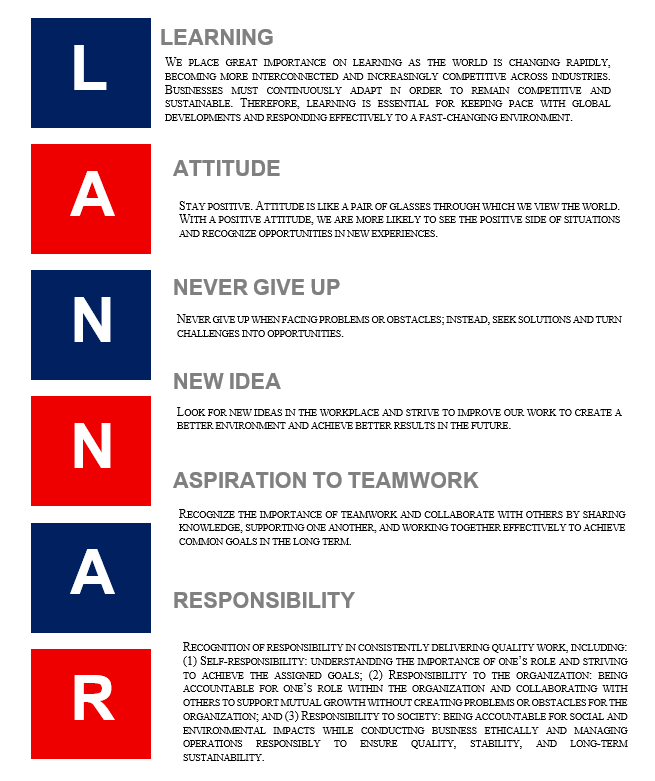
LANNAR SPIRIT represents the behaviors that employees learn, uphold, and demonstrate as part of the Lanna identity. It serves as a guiding principle that shapes employee conduct within the organization by encouraging positive behaviors and regulating inappropriate actions. Moreover, it conveys the Company’s corporate values to stakeholders, including shareholders, customers, business partners, employees, communities, and society.
Material Changes & Developments
Material Changes & Developments
| Year | Description |
|---|---|
| 2,021 | On August 30, 2021, Lanna Power Generation Company Limited (“LPG”), a subsidiary of LANNA, provided financial assistance to SRT Power Pellet Company Limited (“SRT”), a subsidiary of LPG engaged in the production and distribution of wood pellets. Due to the impact of the COVID-19 pandemic, SRT experienced a shortage of raw materials and was required to temporarily suspend its production. To support its financial obligations, LPG granted a loan of Baht 70,820,758.18 to SRT to repay its existing loan from Kasikornbank Public Company Limited. |
| 2,021 | The Board of Directors’ Meeting No. 6/2021 of Lanna Resources Public Company Limited, dated December 20, 2021, resolved to approve the restructuring of the Company’s investment in SRT Power Pellet Company Limited (“SRT”), a subsidiary engaged in the production and distribution of wood pellets. The Company indirectly held 99.99965 percent of SRT’s paid-up capital through Lanna Power Generation Company Limited (“LPG”). The restructuring was intended to enhance management flexibility and operational efficiency by transferring SRT’s business operations to LPG. Upon completion of the business transfer, SRT will proceed with its dissolution and liquidation. |
| 2,023 | On July 20, 2023, the Extraordinary General Meeting of Shareholders of SRT Power Pellet Company Limited (“SRT”) unanimously approved the dissolution of SRT. The dissolution was registered on the same day, and the Company is currently in the process of liquidation. |
| 2,024 | On October 4, 2024, there was a change in the shareholding structure of the Company’s major shareholder. Siam City Cement Public Company Limited (“SCCC”) increased its shareholding in the Company from 44.99% to 61.44% of the Company’s total voting rights. This resulted from a tender offer for the Company’s securities made by Sunrise Equity Company Limited (“Sunrise”) together with Siam City Cement Public Company Limited (“SCCC”), the Company’s major shareholder (collectively referred to as the “Tender Offerors”), during the period from August 29, 2024 to October 2, 2024, in accordance with the criteria relating to the acquisition of significant control in a juristic person that already holds shares in the company (Chain Principle). |
| 2,024 | In March 2024, a resolution was approved for the Company to invest in a solar power plant project to generate and supply electricity to the plant of Thai Agro Energy Public Company Limited (“TAE”), located in Dan Chang District, Suphan Buri Province. The Company assigned Lanna Power Generation Company Limited (“LPG”), a subsidiary company, to invest in and develop a ground-mounted solar power project (Solar Farm) with a capacity of 1.20 megawatts (MW). The electricity generated will be supplied to TAE under a Private Power Purchase Agreement (Private PPA) for a period of 15 years. The project has an estimated investment budget of approximately Baht 25 million, with commercial operation expected to commence by May 2026. |
| 2,021 | On August 31, 2021, Lanna Resources Public Company Limited invested in a new coal mining concession project in Indonesia through PT Pesona Khatulistiwa Nusantara (“PKN”), representing 10 percent of PKN’s total shares, with a total investment of USD 5 million. PKN has been granted a Third Generation Coal Contract of Work (CCoW) by the Government of Indonesia with a concession period of 30 years (2009–2039). The coal mining concession is located in Bulungan Regency, North Kalimantan, Indonesia. |
| 2,021 | On August 30, 2021, Lanna Power Generation Company Limited (“LPG”), a subsidiary of LANNA, provided financial assistance to SRT Power Pellet Company Limited (“SRT”), a subsidiary of LPG engaged in the production and distribution of wood pellets. Due to the impact of the COVID-19 pandemic, SRT experienced a shortage of raw materials and was required to temporarily suspend its production. To support its financial obligations, LPG granted a loan of Baht 70,820,758.18 to SRT to repay its existing loan from Kasikornbank Public Company Limited. |
| 2,020 | On March 4, 2020, Lanna Power Generation Company Limited (“LPG”), a subsidiary of Lanna Resources Public Company Limited (“LANNA”), invested in the acquisition of ordinary and preferred shares of SRT Power Pellet Company Limited (“SRT”) to invest in SRT’s wood pellet production and distribution project in the proportion of 99.9998 percent of SRT’s paid-up capital. The project’s production plant is located in Kian Sa District, Surat Thani Province, with a wood pellet production capacity of 60,000 metric tons per year. |
| 2,019 | Lanna Resources Public Company Limited (“LANNA”) approved PT Lanna Harita Indonesia (“LHI”) and PT Singlurus Pratama (“SGP”), its subsidiaries in Indonesia, to sign amendments to their coal mining concession agreements with the Ministry of Energy and Mineral Resources of Indonesia (“MEMR”) in order to divest foreign or non-Indonesian shareholding from 65 percent to not more than 49 percent of the paid-up capital, in accordance with Indonesian law (Mining Law No. 4/2009). Following the divestment of LANNA’s shareholding in LHI and SGP, LANNA will retain management control over both subsidiaries, allowing their financial statements to continue to be consolidated into LANNA’s consolidated financial statements. In 2019, LANNA has completed the share valuation process and submitted the offer to the relevant government agencies in Indonesia. The divestment process is currently ongoing, with the Indonesian authorities reviewing the acquisition of the divested shares in accordance with the applicable divestment procedures. |
| 2,016 | On July 7, 2016, Lanna Resources Public Company Limited established Lanna Power Generation Company Limited to operate the business of coal-fired power plants and renewable energy, both domestically and overseas. LANNA holds 99.99985 percent of the company’s paid-up capital. |
| 2,008 | In 2008, Lanna (Singapore) Pte. Ltd. invested in the acquisition of ordinary shares in PT Singlurus Pratama, the holder of a third-generation coal mining concession in Indonesia, representing 65 percent of the paid-up capital. Subsequently, in 2009, all ordinary shares in PT Singlurus Pratama were transferred to Lanna Resources Public Company Limited, which now directly holds the shares. |
| 2,005 | In 2003, Lanna Resources Public Company Limited (“LANNA”) invested in the acquisition of ordinary shares in Thai Agro Energy Public Company Limited (“TAE”), representing 75 percent of TAE’s paid-up capital. In 2005, LANNA increased its shareholding to 75.75 percent to engage in the production and distribution of ethanol (99.5% high-purity ethanol) for biofuel applications used in general automobiles. On June 2, 2014, TAE was listed on the Stock Exchange of Thailand (SET) to raise funds for investments aimed at enhancing efficiency in ethanol production and distribution. As part of the listing, LANNA reduced its shareholding from 75.75 percent to 51 percent. TAE commenced trading on the Stock Exchange of Thailand on 5 June 2014. |
| 1,998 | In 1998, Lanna (Singapore) Pte. Ltd. invested in the acquisition of ordinary shares in PT Lanna Harita Indonesia, representing 55 percent of the paid-up capital, to undertake its first coal mining project in Indonesia. The project commenced coal production and distribution in 2001. Subsequently, in 2007, all ordinary shares in PT Lanna Harita Indonesia were transferred to Lanna Resources Public Company Limited, which now directly holds the shares. |
| 1,997 | In 1997, Lanna Resources Public Company Limited established Lanna (Singapore) Pte. Ltd. in Singapore, holding 100 percent of the paid-up capital, to operate as a holding company investing in coal mining and utility businesses overseas. Subsequently, on June 28, 2012, the Company registered the dissolution and liquidation of Lanna (Singapore) Pte. Ltd. as part of an investment restructuring to enhance operational efficiency. |
| 1,996 | In 1996, Lanna Resources Public Company Limited jointly invested an establishment of United Bulk Shipping Pte. Ltd. in Singapore, holding 49 percent of the paid-up capital, to engage in the ocean freight shipping business. |
| 1,985 | Lanna Resources Public Company Limited, formerly Lanna Lignite Public Company Limited, was initially established as Lanna Lignite Company Limited on October 4, 1985, to enter into a sublease agreement for lignite coal mining at Ban Pa Kha Subdistrict, Li District, Lamphun Province with the Department of Alternative Energy Development and Efficiency. The sublease agreement was signed on November 11, 1985, for a period of 20 years, ending on November 11, 2005. The Company was subsequently converted into a public company under the name “Lanna Lignite Public Company Limited” on December 29, 1992. The Company was approved for the listing of its ordinary shares on the Stock Exchange of Thailand (SET) on July 12, 1994, under the Resources Industry Group (Energy and Utilities Sector). On May 17, 2001, the Company registered a change of its name to “Lanna Resources Public Company Limited.” |
Use of Proceeds from Securities Offerings
Is There Money Raised from a Securities Offering Still to Report On?
No
Commitments Made in the Registration Statement
Are There Commitments or Conditions from an Offering or Listing?
No
Group Operating-Structure Policy
Description
The Board of Directors established policies for the operations of subsidiaries and affiliated companies in which the Company has made significant investments, providing oversight appropriate to specific nature of each business and ensuring a clear and accurate understanding as follows:
(1) The Board of Directors has established the following policies to oversee subsidiaries:
(1.1) The Board of Directors appoints individuals asdirectors, executives, or persons with controlling authority in subsidiaries through an established procedure to ensure alignment with the operations of the parent company.
(1.2) The scope of authority, duties, and responsibilities of representatives appointed under item (1)is defined, and they must act in accordance with the policies of the subsidiary. In cases where the subsidiary has other investors, the appointed representatives should perform their duties to the best of their ability to protect the interests of the subsidiary and ensure consistency with the parent company's policies.
(1.3) Establish an internal control system and risk management system for subsidiaries that is appropriate, robust, and sufficient, ensuring that all transactions are conducted in compliance with relevant laws and regulations.
(1.4) Ensure the disclosure of financial status, performance, and transactions with related parties, including the acquisition or disposal of assets and other significant transactions, such as capital increases, reductions, and the liquidation of subsidiaries. These disclosures must be sufficiently detailed and transparent.
(2) Establish criteria for significant investments in other businesses, such as businesses where the Company holds a share of 20 percent to 50 percent of the investment amount, or where there may be a substantial future investment commitment. In cases where necessary, the Board of Directors may require the preparation of a Shareholders’ Agreement or other agreements to clarify the authority in management and participation in important decision-making processes.
(3) Monitor the performance of subsidiaries to ensure the data is accurate and can be used in preparing the company’s consolidated financial statements in accordance with the specified standards and timeframes.
Income Structure
Product / Service Income
| Category | Description | This Year | This Year % | Last Year | Last Year % | 2 Years Ago | 2 Years Ago % |
|---|---|---|---|---|---|---|---|
| Total revenue from operations | Total revenue from operations | 15,187,507.27 | 100 | 20,957,657.21 | 100 | 22,978,248.3 | 100 |
| Revenues from Coal Sales | 13,201,561.29 | 86.92 | 18,521,234.11 | 88.38 | 20,228,892.01 | 88.03 | |
| Revenue from Ethanol Business and Soil Conditioner Byproduct | 1,949,992.32 | 12.84 | 2,262,041.24 | 10.79 | 2,644,780.55 | 11.51 | |
| Other Revenues | 35,953.66 | 0.24 | 174,381.86 | 0.83 | 104,575.74 | 0.46 | |
| Other | Other | 0 | 0 | 0 | 0 | 0 | 0 |
Export Income
| Category | Description | This Year | This Year % | Last Year | Last Year % | 2 Years Ago | 2 Years Ago % |
|---|---|---|---|---|---|---|---|
| Total revenue | Total revenue from operations | 15,187,507.27 | 100 | 20,957,657.21 | 100 | 22,978,248.3 | 100 |
| Domestic | Domestic | 3,072,505.68 | 20.23 | 4,133,970.94 | 19.73 | 4,576,034.49 | 19.91 |
| International | International | 12,115,001.59 | 79.77 | 16,823,686.27 | 80.27 | 18,402,213.81 | 80.09 |
| Indonesia | Indonesia | 12,115,001.59 | 100 | 16,823,686.27 | 100 | 18,402,213.81 | 100 |
| Other countries | Other countries | 0 | 0 | 0 | 0 | 0 | 0 |
Other Income
| Operating Other Income | Non-Operating Other Income | Share of Profit |
|---|---|---|
| 1710 · As of year: 35953.66 · Description: Total other income · As of yesteryear: 174381.86 · As of year before yesteryear: 104575.74 · 1711 · As of year: 35953.66 · Description: Other income from operations · As of yesteryear: 103472.72 · As of year before yesteryear: 104575.74 | 1712 · As of year: 0.0 · Description: Other income not from operations · As of yesteryear: 70909.14 · As of year before yesteryear: 0.0 | 1713 · As of year: 60598.75 · Description: Share of profit · As of yesteryear: 58782.2 · As of year before yesteryear: 123787.32 |
Product / Service Characteristics
Business Type
3114
Business Groups
| Business Group | Description | ||||||||||||||||||||||||||||||||||||||||||||||||||||||||||||||||||||||||||||||
|---|---|---|---|---|---|---|---|---|---|---|---|---|---|---|---|---|---|---|---|---|---|---|---|---|---|---|---|---|---|---|---|---|---|---|---|---|---|---|---|---|---|---|---|---|---|---|---|---|---|---|---|---|---|---|---|---|---|---|---|---|---|---|---|---|---|---|---|---|---|---|---|---|---|---|---|---|---|---|---|
| Domestic Coal Business |
|
Research & Development
Has R&D Policy (Y/N)
No
R&D Cost — Label
Research and development (R&D) expenses over the past 3 years (Million Baht)
R&D Cost — This Year
0.0
R&D Cost — Last Year
0.0
R&D Cost — 2 Years Ago
0.0
Assets Used in the Business
Permanent Assets — Description
Category/Type of Asset | Owner | Objective | Book Value as at December 31, 2025 (Unit: Million Baht) |
(A) Land and Land Improvement | |||
(1) Ayutthaya Coal Distribution Center, having area of 31 rai 56.40 square wah | LANNA | Warehouse and Coal Distribution Center | 245.26 |
(2) Indonesia Coal Mine (2ndCoal Concession) | SGP | Coal Mining | 16.62 |
(3) Suphanburi Province, having area of 1,851 ai 1 ngan 45.40 square wah | TAE | Ethanol Production Plant Location | 317.59 |
(B) Buildings and Structures | |||
(1) Ayutthaya Coal Distribution Center | LANNA | Warehouse and Coal Distribution Center | 18.71 |
(2) Indonesia Coal Mine (1stCoal Concession) | LHI | Coal Mining | 3.57 |
(3) Indonesia Coal Mine (2ndCoal Concession) | SGP | Coal Mining | 75.65 |
(4) Ethanol Production Plant | TAE | Ethanol Production | 309.76 |
(C) Machinery and Equipment | |||
(1) Ayutthaya Coal Distribution Center | LANNA | Warehouse and Coal Distribution Center | 60.29 |
(2) Indonesia Coal Mine (1stCoal Concession) | LHI | Coal Mining | 34.28 |
(3) Indonesia Coal Mine (2nd Coal Concession) | SGP | Coal Mining | 669.93 |
(4) Ethanol Production Plant | TAE | Ethanol Production | 1,606.71 |
(D) Land, Buildings and Equipment under Procurement/Construction | |||
(1) Ayutthaya Coal Distribution Center | LANNA | Warehouse and Coal Distribution Center | 0.83 |
(2) Indonesia Coal Mine (2ndCoal Concession) | SGP | Coal Mining | - |
(3) Ethanol Production Plant | TAE | Ethanol Production | 0.30 |
Remarks: LANNA = Lanna Resources Public Co., Ltd., LHI = PT. LANNA HARITA INDONESIA, TAE = THAI AGRO ENERGY PUBLIC CO., LTD., SGP = PT. SINGLURUS PRATAMA | |||
LANNA and its subsidiaries own fixed assets including land, buildings, and machinery and equipment used in their business operations. Certain land, buildings, and machinery of some subsidiaries are used as collateral as follows.
Domestic subsidiaries have used certain land and buildings together with machinery, with a net book value as at December 31, 2025, of approximately Baht 925.20 million (2024: Baht 1,020.90 million), as collateral for short-term and long-term loans and credit facilities obtained from a commercial bank.
Overseas subsidiaries have used certain land, machinery, and equipment with a net book value as at December 31, 2025, of approximately USD 11.00 million, or approximately Baht 346.90 million (2024: USD 13.10 million, or approximately Baht 443.60 million), as collateral for short-term and long-term loans and credit facilities obtained from a commercial bank.
LANNA also holds investment properties comprising the Pa Kha mine land in Lamphun Province, where the mining concession has expired and lignite mining operations have ceased, as well as land, buildings, and structures located in Ubon Ratchathani Province and land and buildings in Suphan Buri Province owned by its subsidiaries. As at December 31, 2025, these investment properties had a total net book value of approximately Baht 44.90 million and are currently under consideration for lease and/or sale. The Company expects that the net realizable value in the future will exceed the net book value; therefore, no impairment allowance has been recognized.
Coal Mining Concessions
Subsidiaries in Indonesia have assessed coal reserves in accordance with The Australasian Code for Reporting of Exploration Results, Mineral Resources and Ore Reserves (JORC Code), which is an internationally recognized standard.
PT. Lanna Harita Indonesia, a subsidiary, has been granted a Coal Contract of Work (CCoW) by the Government of Indonesia to explore, mine, and sell coal at the Tanah Merah mining area located in Samarinda and Kutai Districts, East Kalimantan Province, Indonesia. The concession area covers approximately 30,018 hectares or approximately 187,612.5 rai, and has a concession period of 30 years from 2001 to 2031. The mine currently has proven coal reserves of not less than 15 million metric tons. The Company is required to pay royalties to the Government of Indonesia at a rate of 13.50 percent of the selling price.
PT. Singlurus Pratama, another subsidiary, has also been granted a Coal Contract of Work (CCoW) by the Government of Indonesia to explore, mine, and sell coal in Kutai District, East Kalimantan Province, Indonesia. The concession area covers approximately 24,760 hectares or approximately 154,750 rai, with a concession period of 30 years from 2009 to 2039. The mine is estimated to have proven coal reserves of not less than 29 million metric tons. The Company is required to pay royalties to the Government of Indonesia at a rate of 13.50 percent of the selling price.
Intangible Assets — Description
The Company's intangible assets primarily consist of computer software and transferred service fees.
Has Subsidiaries Investment Policy (Y/N)
Yes
Subsidiaries Investment Policy — Description
The Board of Directors establishes policies and oversees the operations of subsidiaries and other entities in which the Company has made significant investments at an appropriate level for each entity to ensure a common understanding and alignment with the Company’s policies, as follows:
(1) The Board of Directors appoints individuals to serve as directors, executives, or persons with controlling authority in subsidiaries in writing to ensure that their operations are aligned with the policies of the parent company.
(2) The scope of authority, duties, and responsibilities of the Company’s representatives as specified in item (1) shall be clearly defined, and such representatives shall perform their duties in accordance with the policies of the subsidiaries. In cases where subsidiaries have other investors, the representatives shall perform their duties to the best of their abilities in order to safeguard the interests of the subsidiaries and ensure alignment with the policies of the parent company.
(3) Subsidiaries are required to establish appropriate and adequate internal control systems and risk management systems to ensure that their operations and transactions comply with applicable laws and relevant regulations.
(4) Subsidiaries are required to disclose information regarding their financial position and operating results, including connected transactions, acquisitions or disposals of assets, and other significant transactions such as capital increases, capital reductions, and dissolution of subsidiaries, in a complete and transparent manner.
The Company also establishes criteria for investments in other entities with significant investments, such as those in which the Company holds shares of 20 percent but not exceeding 50 percent of the investment or where additional significant investments may be required in the future. Where necessary, the Board of Directors may require the preparation of a Shareholders’ Agreement or other agreements to clearly define management authority and participation in decision-making on significant matters.
The Company monitors the operating results of its subsidiaries to ensure that the information can be used for the preparation of the Company’s consolidated financial statements in accordance with applicable accounting standards and within the required timeframe.
Marketing Policy & Competition
Reporting Mode
3117
Marketing Policy (Overall)
In the past year, the Company continued to pursue a proactive marketing strategy while maintaining strong relationships with its existing customer base. The Company focused on strengthening customer confidence in product quality and ensuring timely delivery under volatile energy market conditions.
Industry & Competition (Overall)
Subsequent to the significant increase in global coal prices, with the Newcastle coal price index (“NEWC”) reaching an all-time high of USD 434.02 per metric ton in September 2022 amid the global energy crisis resulting from the COVID-19 pandemic and followed by Russia’s invasion of Ukraine, coal prices declined sharply in early 2023 and entered a rebalancing phase. This adjustment was driven by coal producers accelerating production and supply to the market, alongside a decline in natural gas prices as energy supply concerns gradually eased. In addition, the market gained a clearer understanding of the impacts of the Russia-Ukraine war. In 2023, coal prices adjusted to a range of USD 357.75 to USD 122.16 per metric ton, with an average price of approximately USD 172.79 per metric ton. In 2024, coal prices were in the range of USD 146.38 to USD 119.84 per metric ton, with an average price of approximately USD 134.85 per metric ton, during which price volatility declined. In early 2025, coal prices gradually declined from USD 115.18 per metric ton in January 2025 to a low of USD 94.03 per metric ton in April 2025, before gradually increasing to USD 108.27 per metric ton in December 2025. The average coal price for the period from January to December 2025 was USD 105.37 per metric ton. These price movements were mainly due to adjustments in coal production in response to market conditions as prices fell closer to production costs, as well as high inventory levels at mines, ports, and customers’ facilities.
Coal price movements in the Indonesian coal market, as represented by the Indonesia Coal Index (“ICI”), generally aligned with global market trends. However, price responses tended to lag behind and fluctuate within a narrower range compared to the Newcastle coal price index (“NEWC”). This was due to the Indonesian coal products are largely in the range of medium to low calorific value, for which futures trading activities and derivative markets remain limited. In addition, major buyers such as China and India, both of which primarily rely on domestic coal production and consumption. In China, imported coal is mainly used for blending purposes to improve coal quality and/or to optimize energy costs. Meanwhile, India benefits from geographical advantages and geopolitical flexibility, allowing it to source alternative coal supplies from various regions, including South Africa, the United States, and Russia.
The coal market and industry have rebalanced under current economic conditions. Coal prices are expected to remain stable in 2026; however, increased volatility may arise from geopolitical developments, trade protection policies, and more severe climate-related events, which could have greater impacts on mining operations, logistics activities, and manufacturing operations. In addition, policy measures implemented by both coal-consuming and coal-producing countries to enhance energy security and to strengthen domestic industry protection may also contribute to market volatility.
In the short term, coal prices are expected to increase, supported by demand from China and India, driven by increased coal consumption for residential heating during the winter period from November 2025 to February 2026.
Procurement of Products & Services
Reporting Mode
3116
Per-Business-Group Breakdown
| Procurement | Raw Material Acquisition | No. of Distributors | Production Capacity | Purchase Proportion |
|---|---|---|---|---|
The Company procured and imported coal from joint-venture mines and several partner coal producers in Indonesia. These are high-quality coal sources that precisely meet the demands of coal customers in Thailand. | Procurement and Management of Raw Materials Used in Production or Services Coal Products
Ethanol Products Thai Agro Energy Public Company Limited (a subsidiary) produces and distributes ethanol for use as fuel. The company focuses primarily on purchasing molasses and cassava as the main raw materials for production from domestic producers and trading partners. This is managed by entering into forward purchase contracts to mitigate price risks and handle seasonal fluctuations in raw material volumes. | 4 | Thai Agro Energy PCL · Unit: Liter · Spent: 80.64 · Total: 120750000.0 · Unit code: 2959 | 676466485.23 · Country code: 182 · Country name: Indonesia · Raw material name: Coal · 1344595906.25 · Country code: 211 · Country name: Thailand · Raw material name: Molasses and Cassava |
Nature of Business — Overview
Introduction
Business Type: The Company operates three businesses as follows:
(1) SOLID FUEL : Production and distribution of coal both domestically and overseas
(2) LIQUID BIO-FUEL : Production and distribution of ethanol for use as fuel in Thailand.
(3) RENEWABLE ENERGY : Investment in and provision of services related to renewable energy.
(4) Coal Business
Coal Characteristics
Coal is a fossil fuel consisting of volatile matter, moisture, and minerals, with carbon being the primary combustible element. During combustion, volatile matter and moisture are released, leaving a small amount of ash residue. Coal is generally classified into four grades based on calorific value, volatile matter, and fixed carbon, arranged in descending order of quality as follows: (1) Anthracite, (2) Bituminous, (3) Sub-bituminous, and (4) Lignite. In Thailand, the coal most commonly explored and developed for industrial use is lignite. Coal imported from overseas is primarily bituminous coal, which has a higher calorific value than domestically produced lignite. Coal prices are generally determined based on coal quality parameters, including calorific value, moisture content, volatile matter, fixed carbon, ash content, sulfur content, and coal size.
Coal Production
Coal is formed from plant remains that have been compacted, hardened, and chemically altered under heat and pressure over millions of years. The development of a coal mine therefore requires exploration activities to collect and analyze geological data in order to determine coal seam thickness, resource boundaries, coal quality and chemical composition, and commercially recoverable reserves. The information obtained from these exploration serves as the basis for the development of coal deposits. Accordingly, coal production generally consists of three major stages, as follows:
(1) Coal Exploration : Exploration begins with the study of surface geological data and geological structures to identify preliminary target areas. This is followed by scout drilling to examine the accumulation of soil and rock layers and the geological structure of the area in order to confirm the presence of coal deposits. The process also includes the assessment of coal quality and commercially recoverable reserves to support decision-making on the development of the coal deposit for mining operations.
(2) Coal Mining : Prior to commencing mining operations, detailed drilling is conducted to obtain detailed information about the mining area, including coal reserves and coal quality at each level of coal seam formation, as well as the overburden layers. The information obtained is used to develop the mine master plan, which includes cost analysis, mine development methods, as well as the determination of the volume and areas for overburden removal and coal extraction at each stage, together with the selection of appropriate mining equipment and machinery.
(3) Coal Dressing : Coal extracted from mining operations must undergo a coal dressing process to obtain coal that meets the quality requirements of users or customers. The process includes crushing, sizing, screening, and the removal of impurities through screening and washing.
Coal Pricing Policy
Coal pricing is primarily determined based on its calorific value, similar to other types of fuel. The coal selling price for each customer may vary depending on several factors, including order volume, coal specifications such as calorific value, credit terms, and other agreed commercial conditions. These factors are considered to ensure fair and consistent pricing for customers. For imported coal, prices are negotiated with each customer and may be based on various trade terms, such as FOB (Free on Board), CIF (Cost, Insurance and Freight), or delivery directly to the customer’s facility, depending on mutually agreed conditions.
Coal Distribution
For domestic coal distribution, the Company sells coal directly to customers without using trading agents. In overseas markets, coal is sold either directly to customers or through trading agents, primarily on a credit-term basis. The Company grants credit terms selectively to long-term customers with stable financial standing. For new customers, the Company mitigates credit risk by requiring a letter of credit (L/C) issued by the customer. Since commencing operations in 1985, the Company has experienced minimal bad debts from coal sales.
Domestic Coal Business : The Company imports coal from its joint-venture mines and other sources in Indonesia for distribution to customers in Thailand. Coal is distributed both through direct delivery to customers and through stock maintained at the Ayutthaya Coal Distribution Center, located in Nakhon Luang District, Phra Nakhon Si Ayutthaya Province, from which coal is further distributed to customers. The Ayutthaya Coal Distribution Center has a total area of 31 rai and 56.40 square wah and has the capacity to store up to 200,000 metric tons of coal. In 2025, the Company held an estimated 6 percent share of the domestic coal market for industrial consumption, excluding coal used for power generation by independent power producers and small power producers. Coal consumption in Thailand in 2025 was primarily used in the cement industry, accounting for approximately 30 percent, while the remaining 70 percent was used for power generation and other industries. This excludes coal consumption for electricity generation by the Electricity Generating Authority of Thailand (“EGAT”). Coal consumption is expected to continue expanding in the future, as coal provides a lower cost per unit of calorific value compared with oil and other fuels.
Overseas Coal Business : The Company has invested in coal mining operations in Indonesia for more than 22 years. Coal produced from the Company’s joint-venture mines in Indonesia is imported and distributed to customers in Thailand, as well as exported to other countries, particularly in the Asian region, including India, Japan, South Korea, Taiwan, and Hong Kong. The coal produced and distributed by the Company is recognized for its consistent quality and reliability, earning the trust of customers in both domestic and international markets. As a result, the Company has established a strong reputation in the coal industry in the Asian region.
PT. LANNA HARITA INDONESIA (“LHI”), a subsidiary registered in Indonesia, in which Lanna Resources Public Company Limited holds a direct shareholding of 55 percent of the paid-up capital, engages in coal mining operations in Samarinda and Kutai, East Kalimantan, Indonesia. LHI has been granted a Coal Contract of Work (CCOW) by the Government of Indonesia for a concession period of 30 years, commencing in 2001. The coal mine has remaining coal reserves of not less than 15 million metric tons. In 2025, LHI produced and sold approximately 3.5 million metric tons of coal, and plans to maintain production and sales at approximately 3.5 million metric tons per year through 2025 and subsequent years, in line with its production plan.
PT. SINGLURUS PRATAMA (“SGP”), a subsidiary registered in Indonesia, in which Lanna Resources Public Company Limited holds a direct shareholding of 65 percent of the paid-up capital, engages in coal mining operations in Kutai, East Kalimantan, Indonesia. SGP has been granted a Coal Contract of Work (CCOW) by the Government of Indonesia with a concession period of 30 years, commencing in 2009. The coal mine has remaining coal reserves of not less than 29 million metric tons. In 2025, SGP produced and sold approximately 4.25 million metric tons of coal. SGP has also developed a new coal deposit within its concession area, namely the Margomulyo Block (“MG”), with production and sales commencing in the third quarter of 2024, with an expected production capacity of approximately 1.5–2.0 million metric tons per year. Coal produced from the MG deposit will utilize the port and jetty facilities of the Argosari Block (“AG”), which is currently in operation. SGP has completed the construction of a second coal preparation plant and the improvement of the coal stockyard area at the jetty, increasing storage capacity to 200,000 metric tons. In addition, SGP has completed the construction and improvement of the jetty facilities, including the installation of an additional coal conveyor belt approximately 1.70 kilometers in length extending to the offshore jetty to support coal production and distribution from both the AG and MG deposits. Total coal production and sales are planned to reach approximately 5 million metric tons in 2026, and approximately 4.5 million metric tons per year thereafter, according to the Company’s production plan. The coal produced is of high calorific value with low sulphur content, which is expected to support strong market demand and good profit margins.
PT. PESONA KHATULISTIWA NUSANTARA (“PKN”), an associated company in Indonesia, in which Lanna Resources Public Company Limited holds a direct shareholding of 10 percent of the total shares, engages in coal mining operations in Bulungan, North Kalimantan, Indonesia. PKN has been granted a Coal Contract of Work (CCOW) by the Government of Indonesia with a concession period of 30 years, commencing in 2009. The coal mine has remaining coal reserves of not less than 120 million metric tons from two major coal deposits. Coal production and sales in 2025 is approximately 5.45 million metric tons, while production and sales in 2026 are planned at approximately 5 million metric tons.
UNITED BULK SHIPPING PTE. LTD.(“UBS”), an associated company in Singapore, in which Lanna Resources Public Company Limited holds a direct shareholding of 49 percent of the paid-up capital, engages in ocean freight shipping and coal trading businesses. UBS supports the Company’s coal business by managing the transportation of imported coal for distribution in Thailand and export to other countries, thereby enhancing logistics efficiency and maintaining competitive transportation costs.
(2) Ethanol Business
Thai Agro Energy Public Company Limited (“TAE”), a subsidiary registered in Thailand in which Lanna Resources Public Company Limited directly holds 51 percent of the paid-up capital, engages in the production and distribution of ethanol (99.5%) for fuel use. TAE operates two ethanol production lines located in Dan Chang District, Suphan Buri Province. Production Line No. 1 has a production capacity of 150,000 liters per day, while Production Line No. 2 has a production capacity of 200,000 liters per day, a total production capacity of 350,000 liters per day. The plants utilize molasses and cassava as the main raw materials. Both ethanol production lines have been granted investment promotion privileges under the Investment Promotion Act B.E. 2520. Ethanol is a clean fuel used for blending with gasoline at 10 percent, 20 percent, and 85 percent, producing gasohol known as E10, E20, and E85, which can be used in general automobiles. The ordinary shares of TAE have been listed on the Stock Exchange of Thailand (SET) since June 5, 2014.
Ethanol-for-Fuel Business :
Ethanol, also known as ethyl alcohol, is produced from agricultural raw materials containing starch or sugar, such as cassava, sugarcane, molasses, and corn. The production process involves converting starch into sugar (for starch-based raw materials), fermenting the sugar into alcohol, and subsequently distilling and dehydrating the alcohol to achieve a purity level of up to 99.5 percent by volume. Ethanol has the molecular formula C2H5OH and a boiling point of approximately 78 C. In general, ethanol is a clear, colorless, and flammable liquid with a high octane rating. When blended with gasoline in appropriate proportions, it produces a cleaner-burning fuel that improves combustion efficiency and helps reduce air pollution by lowering emissions of hydrocarbons, carbon monoxide (CO), and carbon dioxide (CO2), which are major contributors to the greenhouse effect in the atmosphere.
Production of Ethanol for Fuel
Thai Agro Energy Public Company Limited (“TAE”), a subsidiary, produces ethanol for fuel using molasses and cassava as the main raw materials. The ethanol production process consists of four main stages, as follows:
Raw Material Preparation: Each type of raw material requires a different preparation process, as follows:
(A) Molasses : Molasses is diluted with water to achieve appropriate concentration. Acid is then added to remove impurities, such as organic salts, before the solution is sent to the fermentation process.
(B) Cassava : Cassava chips are cleaned to remove contaminants such as metal and dirt. The cleaned cassava chips are ground and mixed with water to produce a starch slurry, which is then hydrolyzed into sugar using enzymes before being sent to the fermentation process.
Fermentation : The prepared solution from the first stage is transferred to fermentation tanks, where yeast is added to convert sugar into alcohol.
Distillation : The fermented mash from the second stage is fed into a distillation column to separate impurities and water, producing alcohol with approximately 96 percent purity, which is the maximum concentration achievable through the conventional fermentation process. The remaining water of 4 percent is removed in the final stage.
Dehydration : The dehydration process removes the remaining water from the distillation stage to produce fuel-grade ethanol with a purity of 99.5 percent. Alcohol vapor passes through two dehydration units containing zeolite molecular sieves, which absorb the remaining water from the alcohol. The dehydrated ethanol is then condensed and cooled before being stored for distribution.
Ethanol Pricing Policy
The Committee on Energy Policy Administration (“CEPA”) has approved the use of a reference ethanol price based on a comparison of the lowest price between the ethanol price reported by producers to the Excise Department and the ethanol price reported by fuel traders under Section 7 of the Fuel Trade Act B.E. 2543 (2000) to the Energy Policy and Planning Office (“EPPO”). This policy has been effective since December 2015. In addition, TAE adopts a cost-plus-margin pricing policy, whereby the selling price is determined based on production costs plus an appropriate gross margin. In addition to considering the reference ethanol price announced by the EPPO, TAE also takes into account other relevant factors in determining the selling price of fuel ethanol, such as raw material costs, market demand and supply conditions, and the overall competitive environment, both in domestic and international markets.
Ethanol Sales and Distribution Channels
According to the regulations of the Excise Department, ethanol used as fuel must first be converted into denatured ethanol by blending ethanol with gasoline or gasohol at a ratio of 0.5 percent to 99.5 percent ethanol by volume. The denatured ethanol is then sold to oil traders under Section 7 of the Fuel Trade Act B.E. 2543 (2000). The oil trading companies subsequently blend the denatured ethanol with gasoline in different proportions to produce gasohol fuels, namely E10, E20, and E85. In most cases, customers are responsible for the transportation of the ethanol purchased. In some cases, the seller arranges transportation and delivers the ethanol to the customers’ storage facility. Ethanol sales are primarily conducted on a credit term basis, with customers being large oil companies with stable financial status, thereby minimizing the risk of potential non-payment by customers.
Competitive Strategy
Priority is given to service excellence, product quality control, and ensuring timely product delivery as key strategies to build customer confidence. These strategies enable the Company to maintain strong relationships with customers and retain a significant share of the market.
Ethanol Industry Trend
Average ethanol consumption in 2025 was approximately 3.46 million liters per day, comparable to the level recorded in 2024. This was due to the slowdown in economic conditions, together with the lack of clear policy direction regarding the promotion of E20 gasohol as the base gasoline fuel.
Demand for Ethanol-for-Fuel
Description | (Unit : Million Liters) | |||||
2020 | 2021 | 2022 | 2023 | 2024 | 2025 | |
Ethanol Consumption Volume | 1,519.98 | 1,353.85 | 1,393.60 | 1,288.45 | 1,251.95 | 1,262.42 |
Average Daily Ethanol Consumption | 4.00 | 3.71 | 3.83 | 3.53 | 3.43 | 3.46 |
Source: Department of Alternative Energy Development and Efficiency, Ministry of Energy | ||||||
Gasohol Industry Trend
Since ethanol used as fuel is blended with gasoline in specific proportions to produce gasohol fuels, namely E10, E20, and E85, the domestic demand for ethanol is directly driven by gasohol consumption. In 2025, domestic gasohol consumption increased by approximately 0.37 million liters per day, or an increase of 1.2 percent compared with 2024.
Competitive Trend
In 2025, there are 28 operating ethanol production plants in Thailand, representing a total capacity of approximately 7,020,000 liters per day.
Market Share of Ethanol Business
Year | Domestic Ethanol Consumption | Denatured Ethanol Sales Volume of TAE (Million Liters) | Market Share of TAE (%) |
2020 | 1,519.98 | 104.425 | 6.87 |
2021 | 1,353.85 | 85.352 | 6.30 |
2022 | 1,393.60 | 73.325 | 5.26 |
2023 | 1,288.45 | 88.774 | 6.89 |
2024 | 1,251.95 | 74.663 | 5.96 |
2025 | 1,262.42 | 99.527 | 7.88 |
Remarks:
| |||
Investment and Services Business in Renewable Energy
Lanna Power Generation Company Limited (“LPG”), a subsidiary registered in Thailand in 2016, in which Lanna Resources Public Company Limited holds a direct shareholding of 99.99985 percent of the paid-up capital, was established with the objective of exploring and preparing investments in renewable energy projects both in Thailand and overseas. These include businesses related to biomass energy, as well as the generation and distribution of electricity from biomass fuels. In addition, LPG seeks opportunities to invest in and develop other energy businesses, such as solar energy, wind energy, and electric vehicle charging station projects (EV Charging), or other related projects, which are expected to generate additional revenue and profits for the Company in the future. In 2024, LPG invested in a ground-mounted solar power plant (Solar Farm) with a capacity of 1.20 megawatts to generate and supply electricity to the plant of Thai Agro Energy Public Company Limited (“TAE”), a subsidiary of the Company. The project operates under a Private Power Purchase Agreement (Private PPA) for a period of 15 years, with commercial operation expected to commence by May 2026.
SRT Power Pellet Company Limited (“SRT”), a subsidiary registered in Thailand, in which Lanna Power Generation Company Limited (“LPG”), a subsidiary of the Company, held 99.9998 percent of the paid-up capital through investments in both ordinary and preferred shares. SRT engaged in the production and distribution of wood pellet. Its production plant was located in Kian Sa District, Surat Thani Province, with a production capacity of 60,000 metric tons per year. The main raw materials used in the production process consisted of agricultural and wood residues, such as wood chips, wood scraps from the furniture industry, and rubber tree roots. These materials were processed and compressed into wood pellets suitable for use as fuel in boilers or furnaces for electricity generation, heat production, and various industrial applications. During 2020–2021, SRT was adversely affected by the COVID-19 pandemic, which resulted in a decline in furniture exports and consequently a shortage of wood raw materials used in wood pellet production, together with a significant increase in raw material prices. These factors negatively impacted SRT’s operations and resulted in operating losses. As a result, the Company restructured its investment by having SRT transfer its business operations to LPG and proceeded with the registration of its dissolution and liquidation. Following the completion of the business transfer, LPG will further study the feasibility of producing biomass fuel from alternative raw materials for future distribution to customers. On July 20, 2023, the Extraordinary General Meeting of Shareholders of SRT approved the dissolution of the company, and the dissolution was registered on the same day. SRT is currently in the process of liquidation.
Projects Under Construction
Has Projects Under Construction (Y/N)
No
Debentures & Bills of Exchange
Has Debentures (Y/N)
No
Convertible Securities
Has Convertible Securities (Y/N)
No